The book of Daniel is foundational for understanding the last days, and even the prophet’s name carries deep meaning. Daniel means “G-d is my judge.” This truth becomes increasingly important as the world grows hostile toward biblical faith.
The world may take a believer’s life, but it has no authority to judge from an eternal perspective. What ultimately matters is not how the world sees us, but how G-d sees us. When we walk in faith and allow ourselves to be governed by the truth of Scripture, we will inevitably make decisions that offend the world. We were never called to please the world; we were called to be pleasing to the King of kings.
In Daniel chapter 3, we see a dramatic shift in government policy. A new law is introduced, one that demands worship. The central question is clear: Should the people of G-d submit to this governmental change? The answer is unequivocal—no, because G-d must always come first.
This principle is consistent throughout Scripture. In the book of Acts, the early apostles were confronted with a similar choice. Their response was profound: “Whether it is right in your eyes to obey you rather than G-d, you judge; but we cannot help but obey the word of G-d.” That conviction is precisely what is lacking in many believers today.
Daniel 3 introduces King Nebuchadnezzar, who establishes a massive golden image on the plain of Dura in the province of Babylon. Babylon is not an incidental detail. Biblically and prophetically, Babylon represents idolatry. The book of Revelation later refers to the Antichrist’s empire as Babylon the Great, emphasizing that idolatry will be its defining religious system.
Idolatry always offers humanity a false promise: that one can obtain what they desire without obedience to G-d. It replaces submission to the Creator with devotion to created things—wealth, power, security, and control. This is why idolatry becomes the central strategy of the Antichrist’s empire.
In Daniel 3, all government officials are gathered and commanded to worship the image. Worship is enforced, not invited. Music accompanies the command, creating an emotional and sensory experience designed to compel obedience. Anyone who refuses to bow is immediately sentenced to death in a fiery furnace.
This event is deeply prophetic. Scripture reveals that in the last days, worship will not be optional. Everyone will be forced to worship—but the choice will be who they worship. There are only two options: allegiance to the Antichrist empire or faithfulness to the G-d of Israel and His Messiah.
Shadrach, Meshach, and Abednego represent those who remain faithful. They refuse to bow, even under the threat of death. Their response is not emotional or hesitant; it is decisive and rooted in faith. They declare that G-d is able to deliver them, but even if He does not, they will not worship the image.
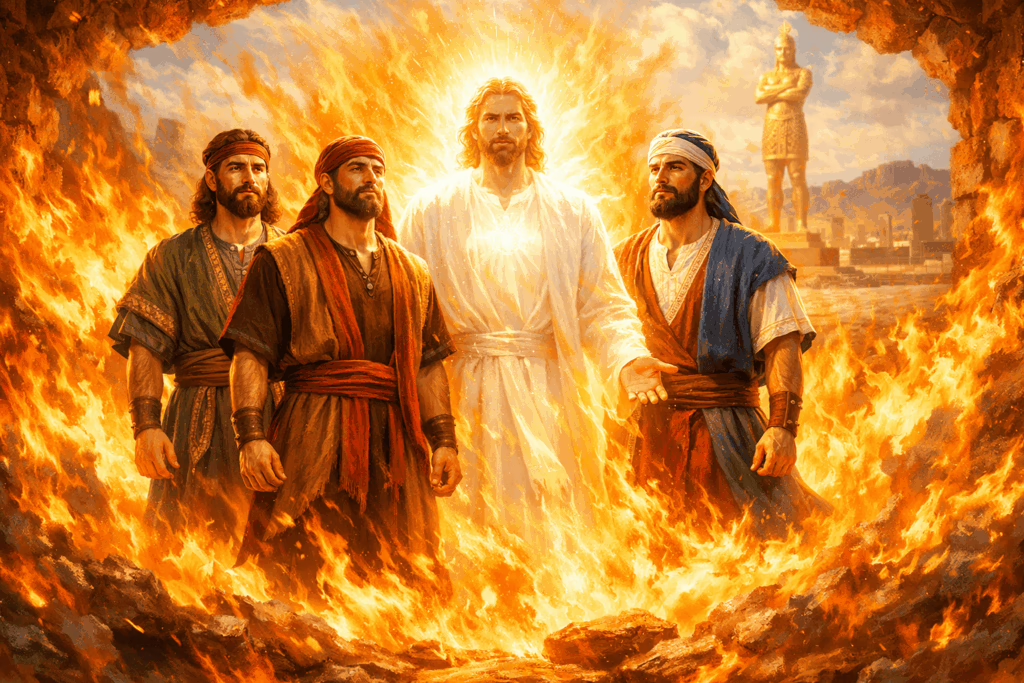
Their faith is tested in the furnace. The fire that kills the soldiers who serve the empire has no power over those who serve G-d. In the midst of the fire, a fourth figure appears—one whose appearance is like the Son of G-d. The bound men walk freely in the flames, untouched and unharmed.
This moment reveals a critical truth for believers in the last days: we are not promised exemption from suffering, but we are promised the presence of G-d. Whether through deliverance or resurrection, G-d remains faithful.
Nebuchadnezzar is transformed by what he witnesses. He acknowledges the Most High G-d and declares that there is no other who can deliver in this way. This passage shows us that true worship is faithfulness—placing nothing above G-d, even when the cost is our lives.
Daniel chapter 3 is not merely history. It is preparation. It teaches us how to stand firm when idolatry becomes law and when faithfulness becomes dangerous. Those who trust G-d, serve Him alone, and surrender fully to His authority will be sustained—now and eternally.
Visit LoveIsrael.org for more Bible teachings, articles, and video messages from Dr. Baruch Korman
You can also watch this full teaching on YouTube at LoveIsrael Channel or listen through the My Bible Study mobile app.