
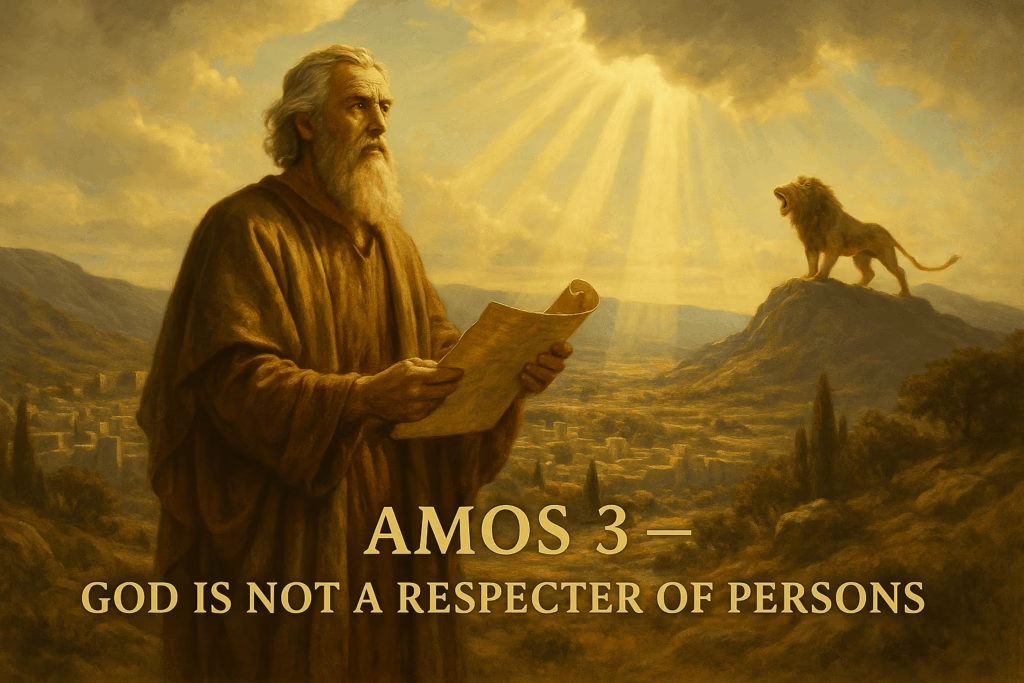
In this week’s study from the prophecy of Amos chapter 3, Dr. Baruch Korman teaches a foundational truth about the character of the G-d of Israel:
“He is not a respecter of persons.”
This means that G-d has no favorites. His blessings and judgments are rooted not in ethnicity or status, but in obedience and faith. Israel was chosen not for privilege, but for purpose — to serve as a vessel of revelation, bringing light and truth to all nations.
Yet, when Israel — or any people — turn from G-d’s Word, they invite discipline. Through Amos, G-d warns His people that disobedience brings consequences, even for those who have experienced redemption.
Israel’s Calling: Chosen for Purpose, Not Favoritism
“Hear this word which the L-RD has spoken against you, O children of Israel…” (Amos 3:1)
Israel’s deliverance from Egypt was an act of redemption — not a license for rebellion. The Exodus foreshadowed a greater truth: redemption demands response.
G-d reminds His people that He brought them out of Egypt — an event marked by the blood of the Passover lamb. Everyone who left — Jew or Gentile — shared one common experience: faith in the blood.
But having been redeemed, Israel was now accountable to live by the truth they had received.
Accountability for All Nations
G-d’s justice is universal. Every nation, including Israel, is measured by His Word.
“Therefore I will punish you for all your iniquities.” (Amos 3:2)
Redemption does not exempt from judgment — it increases responsibility. Just as light reveals, it also exposes. Israel’s calling as “a light to the nations” meant they were to reflect G-d’s truth, not conceal it.
Relationship Requires Agreement
“Can two walk together unless they have agreed?” (Amos 3:3)
To walk with G-d requires agreement with His plans. The journey from Egypt to the Promised Land symbolized a greater spiritual reality — our journey from this world toward the Kingdom of G-d.
Without alignment, there can be no fellowship. Obedience is not optional; it’s the path of intimacy.
Consequences Are Certain
Through a series of rhetorical questions (Amos 3:4–6), G-d illustrates simple truths:
- A lion roars only when it has prey.
- A trap springs only when something triggers it.
- A trumpet sounds in the city — and the people tremble.
Each image declares: actions bring results. Disobedience has consequences, just as faith brings blessing.
“If there is evil in the city, has not the L-RD done it?” (Amos 3:6)
This does not mean G-d authors evil — but that He permits discipline when His people rebel. His sovereignty ensures that nothing happens by accident.
G-d Reveals Before He Acts
“Surely the L-rd G-D does nothing unless He reveals His secret to His servants the prophets.” (Amos 3:7)
Before judgment, there is always warning. Prophets serve as messengers of mercy, giving opportunity for repentance.
G-d’s revelation is His grace in action — inviting His people to turn back before discipline falls.
The Prophet’s Responsibility
“A lion has roared; who will not fear? The Lord G-D has spoken; who can but prophesy?” (Amos 3:8)
Once G-d speaks, the prophet must proclaim. Silence in the face of sin is complicity. The roar of divine warning calls for reverence and repentance.
Amos’s message remains timeless:
G-d desires repentance, not ruin. He longs to forgive, restore, and bless — but will not ignore rebellion.
Conclusion: G-d’s Justice Is Impartial
G-d’s nature is unchanging. He blesses obedience and disciplines disobedience — whether Israel or any other nation.
As believers, we have experienced a greater redemption — through the blood of Messiah Yeshua, the true Passover Lamb. We are new creations, empowered by the Holy Spirit to walk in obedience.
Let us, therefore, respond to His Word with faith, humility, and reverence — living as lights to the nations, proclaiming His truth in word and deed.
“For the L-rd G-D has spoken — who can but prophesy?” (Amos 3:8)
Study more weekly teachings at LoveIsrael.org
Discover more teachings on our channel: