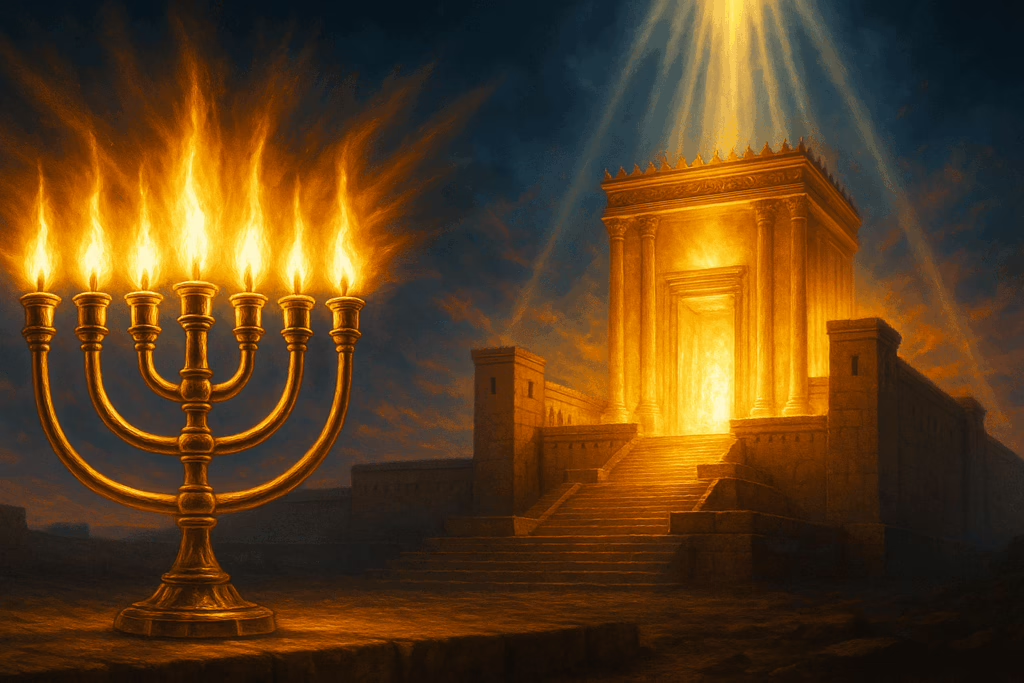
Hidden Clues in the Book of Haggai
For many believers, Hanukkah is often overlooked or considered to have little biblical relevance. But is that perspective truly aligned with Scripture?
The Gospel of John provides a powerful starting point. In John 10:22, we learn that Yeshua Himself went up to Jerusalem specifically to observe Hanukkah—the Feast of Dedication. This alone tells us something important: what mattered to the Son of G-d should matter to us as well. If Hanukkah was significant to Him, then it deserves our attention and careful study.
When we turn to the prophecy of Haggai, we discover that Hanukkah is far more than a historical commemoration. It carries prophetic weight and reveals profound truths about the coming Kingdom of G-d. At its core, Hanukkah speaks of change—specifically, a divine shift in which the empires and governments of this world are overthrown and replaced by G-d’s Kingdom.
This is precisely why the Messiah came into the world. Both John the Baptist and Yeshua proclaimed the same foundational message:
“Repent, for the Kingdom of Heaven is at hand.”
Haggai’s prophecy centers on the rebuilding of the Temple, but not merely as a construction project. The Temple represents G-d’s dwelling place, His authority, and His redemptive purposes on earth. While the people were focused on their own comfort—living in paneled houses—G-d called them to prioritize His house. Their obedience would result in divine presence, blessing, and restoration.
In chapter two, the prophecy reaches its climax. G-d declares that the glory of the latter house will be greater than the former. This is not referring to the first or second physical temples alone, but to the ultimate dwelling place of G-d—His Kingdom fully established. The promise concludes with shalom, peace, defined biblically as the fulfillment of G-d’s will.
Hanukkah is directly tied to this promise. The date emphasized repeatedly in Haggai— the 24th day of the ninth month—marks the beginning of Hanukkah. From that day forward, G-d announces a shift. A redemptive process is set in motion that culminates in the establishment of His Kingdom.
Daniel chapter 12 reinforces this timeline, pointing to a blessed period following 1,335 days—a number deeply connected to redemption. From Yom Kippur to Hanukkah, there are exactly 75 days, a number consistently associated in Scripture with deliverance and restoration.
Hanukkah, then, is not merely about remembering a miracle of oil or a military victory. It is about dedication through victory, G-d’s presence among His people, and the certainty that His Kingdom will replace all others.
Yeshua Himself stood in the Temple during Hanukkah, near the Holy of Holies, signaling what is yet to come. One day, He will return, enter the Holy of Holies, and establish the Kingdom of G-d in fullness.
Hanukkah declares restoration, salvation, victory, and glory. It calls G-d’s people to dedicate themselves anew—to revere His Word, obey His Spirit, and live with confidence in His promises.
Join us for a special livestream exploring the prophetic meaning of Hanukkah through the message of Haggai. Discover how this often-overlooked prophet speaks to the themes of rededication, restoration, and G-d’s future promises—all tied to the season of Hanukkah.