
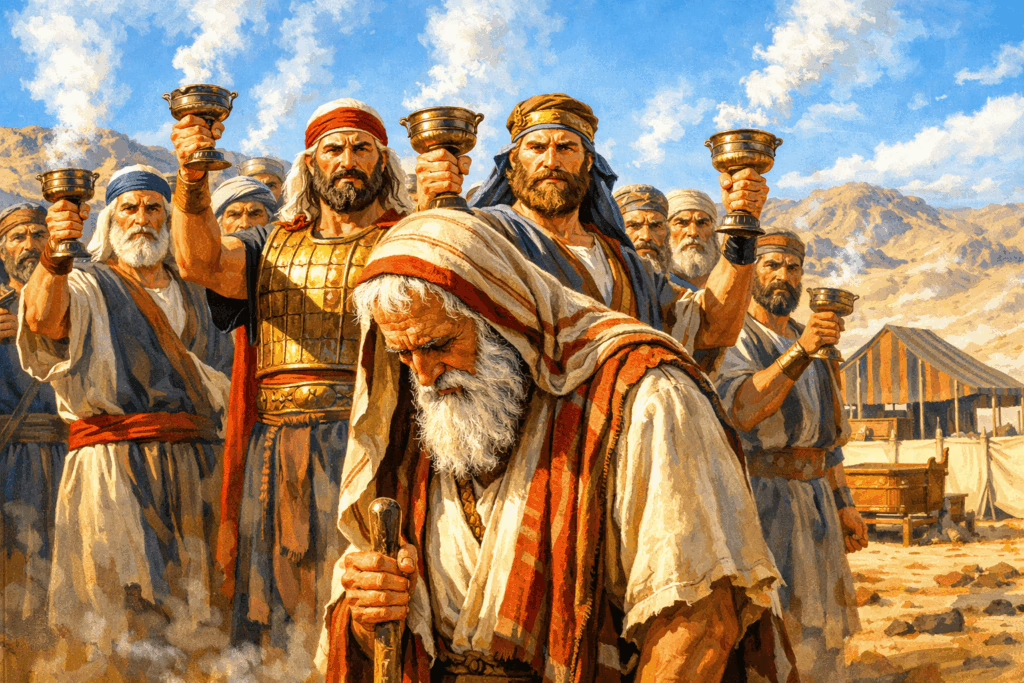
One of the recurring themes throughout Scripture is rebelliousness against the order that G-d Himself establishes. In Numbers chapter 16, we encounter one of the most serious rebellions in the history of Israel—a rebellion not led by outsiders or marginal figures, but by respected leaders within the community.
The text introduces a group of 250 men of reputation, men of renown, leaders who held influence and honor among the people of Israel. These were not insignificant individuals. They represented authority, status, and recognition. Yet despite their elevated position, they allowed dissatisfaction and ambition to give birth to rebellion.
At the center of this uprising stood Korach, a Levite from the family of Kehat. Though he had been set apart for sacred service in the Tabernacle, Korach was not content with the role G-d had assigned to him. Alongside Datan, Aviram, and others from the tribe of Reuven, he challenged the leadership of Moshe (Moses) and Aaron.
Their accusation was clear: “You have taken too much upon yourselves.” In their eyes, Moshe and Aaron had exalted themselves above the congregation. Yet Scripture reveals a deeper truth—this rebellion was not truly against Moshe and Aaron, but against G-d Himself.
The rebels argued that “all the congregation is holy” and that G-d was equally among everyone. While this statement sounded spiritual, it was fundamentally false. Holiness is not self-assigned; it is granted by G-d according to His calling and purpose. Leadership in Israel was not seized by ambition but established by divine choice.
Moshe’s response reveals his character. Rather than defending himself, he fell on his face in humility. He entrusted the matter entirely to G-d, declaring that by the next morning, G-d Himself would reveal whom He had chosen as holy and set apart.
The test involving the censers made one truth unmistakably clear: service before G-d is not defined by desire, popularity, or reputation, but by divine calling. The Levites involved in the rebellion were not satisfied with serving; they wanted the priesthood. Their ambition exceeded obedience.
As the narrative unfolds, the rebellion exposes its true heart. The rebels referred to Egypt—the land of bondage—as a land flowing with milk and honey. This tragic distortion reveals the essence of rebellion: a corrupted vision. When people lose sight of G-d’s promises, they begin to romanticize what He has already redeemed them from.
The wilderness was not a place of death, but a place of learning—learning to trust, depend on, and rely fully upon G-d. Rebellion arose because these leaders desired position rather than purpose, authority rather than obedience.
Scripture teaches us a timeless principle: true success is not achieving personal ambition, but walking humbly within the will of G-d. Faith—not works—brings righteousness, just as Abraham believed and it was accounted to him as righteousness. Obedience flows from faith; it does not replace it.
The fate of the 250 rebels stands as a warning to every generation. Reputation without submission, leadership without humility, and ambition without obedience lead only to judgment.
The question remains for each of us:
Do we desire the things of G-d, or merely the positions we imagine for ourselves?
True success is found in humility, faith, and commitment to the purposes of G-d. Shalom.
Visit LoveIsrael.org for more Bible teachings, articles, and video messages from Dr. Baruch Korman.
You can also watch this full teaching on YouTube at the LoveIsrael Channel or listen through the My Bible Study mobile app.