
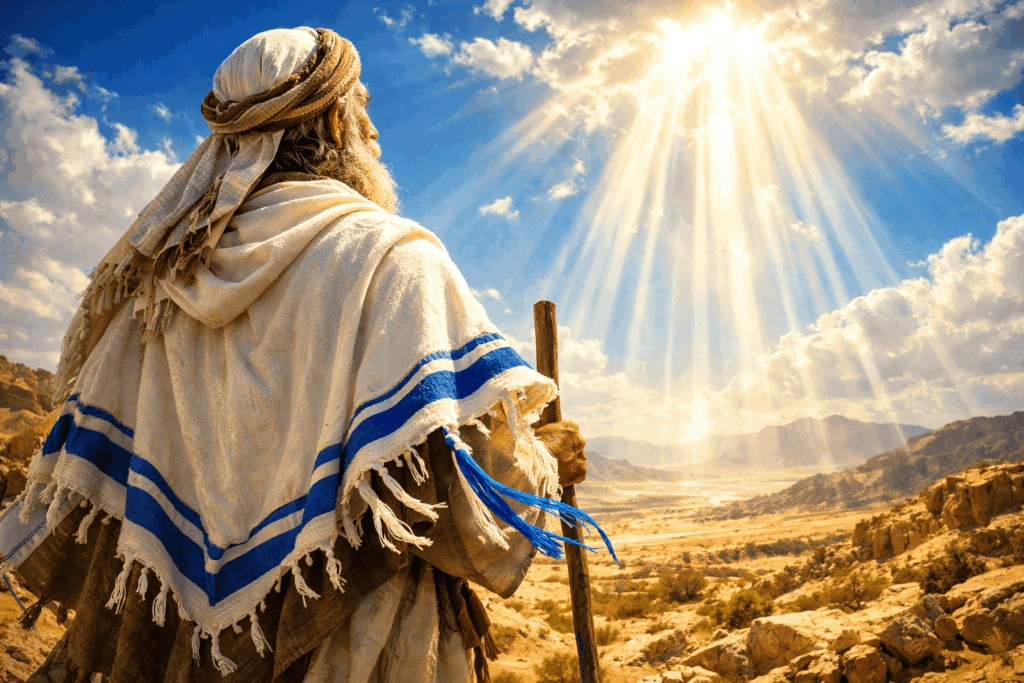
As we examine the book of Numbers, we find that G-d uses the wilderness—midbar in Hebrew—as a classroom. For forty years, the children of Israel lived in the desert, and during that time G-d sought to teach them one foundational truth: to trust in Him, depend upon Him, rely upon Him, and recognize that He is always faithful.
Our G-d is forever faithful. There is nothing unfaithful about Him. However, if we desire to experience His faithfulness in our lives, we must be committed to His will, His plans, and His purposes. When we walk within the will of G-d, we can expect His provision, His help, and His presence to be active realities in our lives.
In the final section of Numbers chapter 15, G-d gives a commandment that at first glance may seem simple or even symbolic, yet it carries profound spiritual meaning. To understand it properly, we must approach it with a biblical mindset, not through speculation or tradition alone.
Beginning in verse 37, Scripture states: “And the L-rd said to Moses, saying.” This phrase highlights divine revelation. G-d is communicating His truth directly. In verse 38, G-d commands Moses to speak to the children of Israel and instructs them to make tzitzit on the corners of their garments throughout their generations.
The phrase “for themselves” is significant. Whenever G-d uses this language, He is revealing something that serves our best interest. G-d does not command because He lacks anything. He is perfect, self-existent, and complete. Every commandment He gives is designed for our benefit, not His.
The tzitzit are placed on a four-cornered garment, one on each corner. Each tzitzit contains threads and knots that point to the totality of G-d’s commandments—613 in number—representing both what we are called to do and what we are called to avoid. Among these threads is one blue thread, symbolizing heavenly authority, reminding us that our obedience is connected to G-d’s kingdom purposes.
Verse 39 explains the purpose clearly: “And it shall be for you a tzitzit, that you may look upon it and remember all the commandments of the L-rd and do them.” This is not metaphorical. Scripture explicitly states that the tzitzit represent the commandments of G-d. Seeing them leads to remembering, and remembering leads to obedience.
This remembrance has a powerful result: “That you do not stray after your own heart and your own eyes.” In biblical language, the heart represents our thoughts, and the eyes represent what we desire. When people live apart from faith and revelation, they follow their own reasoning and impulses, which leads to sin and spiritual compromise.
Scripture warns that following our own thoughts and desires leads to spiritual harlotry—idolatry of self, pleasure, and worldly values. G-d calls His people to walk by faith, not by sight. Faith comes from hearing the word of G-d, not from reacting to what we see.
Verse 40 reinforces this truth through repetition, emphasizing its importance: remembering and doing G-d’s commandments leads to holiness. Obedience does not produce salvation; salvation produces obedience. The law reveals G-d’s definition of righteousness, not a method for earning redemption.
Redemption comes through faith—faith in the death, burial, and resurrection of Messiah Yeshua. His sacrifice on Passover accomplished eternal redemption. Through that redemption, we become a new creation, indwelt by the Holy Spirit, empowered to obey G-d from the heart.
As redeemed people, we are called to live faithfully. Faithfulness produces righteousness, and righteousness manifests the glory of G-d. Humanity was created to reflect His character, and obedience aligns us with that purpose.
The chapter concludes by tying obedience to redemption. G-d reminds Israel that He brought them out of Egypt through redemption, establishing a covenant relationship with them. In the same way, the new covenant—established through the blood of Messiah Yeshua—is eternal, unbreakable, and rooted in grace.
Eternal redemption produces eternal life. Eternal life cannot end, be revoked, or diminished. Our assurance rests entirely on what Messiah has done, not on what we have done. Because of His sufficiency, we are forever the righteousness of G-d.
Everything G-d commands is for our good. He does not need anything from us. His instructions exist so that it may be well with us. When we walk in covenant with Him—specifically the new covenant—we become recipients of His goodness, His promises, and His blessings.
This is the message of Numbers 15: remember, obey, walk in faith, and trust the faithfulness of G-d.
Shalom from Israel.
Visit LoveIsrael.org for more Bible teachings, articles, and video messages from Dr. Baruch Korman
You can also watch this full teaching on YouTube at LoveIsrael Channel or listen through the My Bible Study mobile app.