Numbers chapter 16 begins by introducing a group commonly translated as a “congregation.” However, the Hebrew term does not merely describe a religious assembly but rather a group of witnesses. Scripture consistently teaches that our primary witness is not our words but our behavior, our actions, and our fruit. A consistent walk—guided by the Holy Spirit—reveals a heart committed to the will, purposes, and plans of G-d.
Believers are called to live sacrificially in a way that is well-pleasing to G-d. This principle forms the foundation for understanding the rebellion led by Korah.
Korah and the 250 men who followed him did not merely oppose Moses; they opposed the character and authority of G-d. Their rebellion was rooted in jealousy, pride, and false accusation. Moses, fully aware of their hearts, responded with righteous anger, not personal offense.
Moses declared before G-d that he had acted faithfully, without self-interest, and without violating the will of G-d. His leadership was not self-appointed but divinely revealed.
The Test of Divine Choice
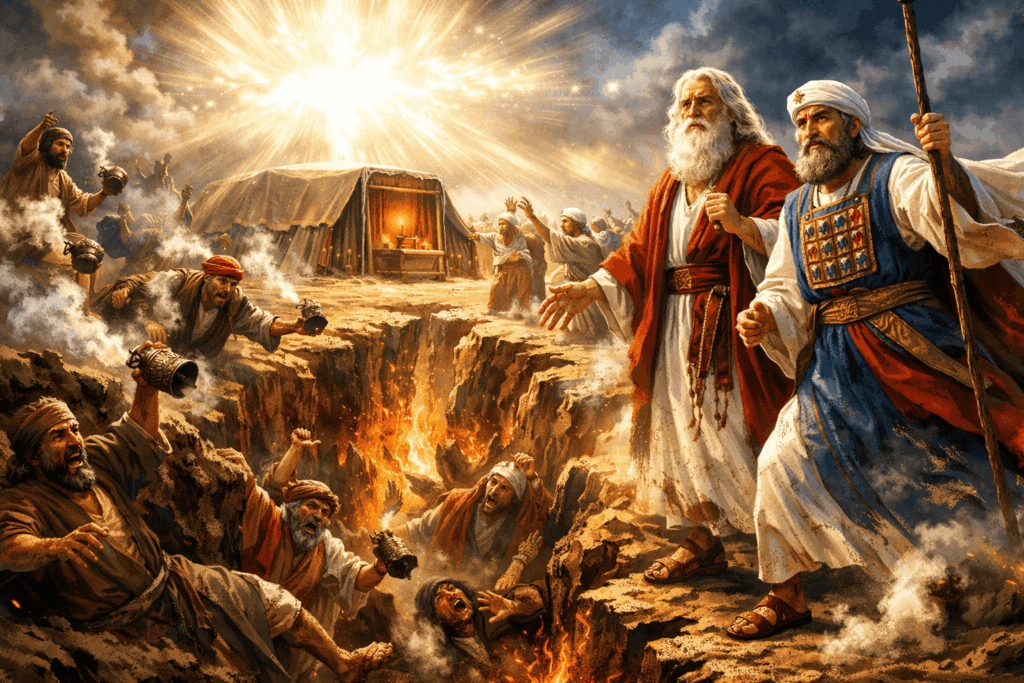
Moses instructed Korah and his followers to appear before the L-rd with censers and incense. This was not a random act but a divinely ordained test. G-d Himself would reveal whom He had chosen.
As the group assembled at the entrance of the Tent of Meeting, the glory of the L-rd appeared, visibly marking the presence of G-d. This manifestation signaled that judgment and revelation were imminent.
Separation Before Judgment
G-d commanded Moses and Aaron to separate from the rebellious group—a term rooted in Genesis, where G-d distinguished light from darkness. Separation precedes judgment.
Moses warned the people to move away from the dwellings of Korah, Dathan, and Abiram, identifying them explicitly as wicked men—those committed to what stands in opposition to the will of G-d.
A Sobering Judgment
The ground opened and swallowed Korah, his followers, their households, their possessions, and even their very young children. Scripture emphasizes that they went down alive into Sheol—the realm of the dead. This extraordinary judgment confirmed that Korah and his followers had blasphemed the L-rd.
This event demonstrates a critical truth: G-d is holy and righteous, and His judgments are always just, even when they challenge human assumptions.
The Gospel Hope and the Fear of the L-rd
The judgment caused all Israel to flee in fear, recognizing the seriousness of standing against G-d. Scripture reminds us that G-d is both merciful and just. The only escape from divine judgment is through the work of Messiah.
Through faith in Messiah—His death, burial, and resurrection—we are redeemed and declared righteous. Because of this, believers can await the Day of Judgment with confidence, knowing that Messiah bore our sin and granted us His righteousness.
Biblical Worship: The Central Lesson
At the heart of Korah’s rebellion was a misunderstanding of biblical worship. Worship is not defined by human preference but by divine instruction. G-d alone determines how He is to be worshiped.
Moses and Aaron served G-d according to His revelation, not personal ambition. Korah sought equality without submission, authority without calling, and worship without obedience.
Believers today must learn how to worship G-d biblically—according to His Word and His will. True worship flows from humility, obedience, and reverence.
May we be found faithful witnesses, living consistently, worshiping rightly, and serving G-d in a manner that is well-pleasing to Him.
Visit LoveIsrael.org for more Bible teachings, articles, and video messages from Dr. Baruch Korman
You can also watch this full teaching on YouTube at LoveIsrael Channel or listen through the My Bible Study mobile app