There is a dangerous assumption many people make:
“If this were truly from G-d, our leaders and the majority of people would accept it.”
The Word of G-d tells a very different story.
In Numbers 14, we see the people of Israel at a critical moment. They have been redeemed out of Egypt, they have seen miracles, they have been guided by G-d in the wilderness, and they have heard His promises. Yet when they stand on the verge of the Promised Land, the majority choose fear over faith, rebellion over obedience, and Egypt over the will of G-d.
The Night of Complaining
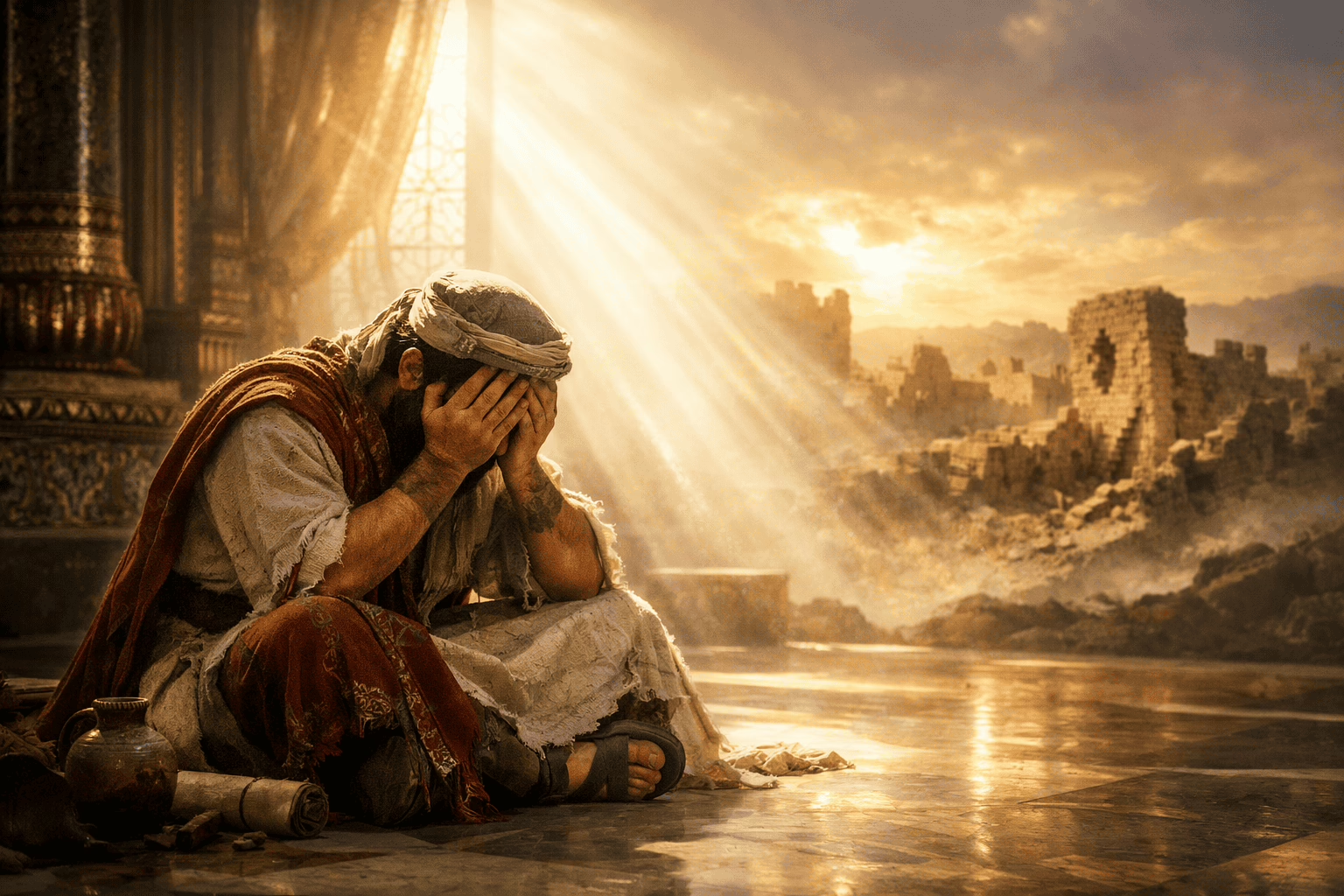
After hearing the report of the spies, the people wept through the night. This was a night that should have been filled with prayer, thanksgiving, and expectation. G-d had led them, fed them, and protected them. He had already proven His power in Egypt and the Red Sea.
Instead of worship, there was weeping.
Instead of gratitude, there was grumbling.
The people cried out,
“If only we had died in Egypt! Or in this wilderness!”
Rather than trusting G-d’s plan for a new life in a good land, flowing with milk and honey, they obsessed over death and defeat. They were not interested in entering into the life that G-d had prepared. They preferred the familiarity of slavery over the risk of obedience.
Complaints Against G-d’s Servants
Their frustration quickly turned against Moses and Aaron.
Scripture tells us, “All the congregation complained against Moses and Aaron.”
This is a recurring pattern in human history: when people refuse G-d’s will, they often attack the servants G-d has raised up to lead them. The issue was not Moses and Aaron. The real issue was their own unwillingness to trust G-d.
They said, in effect:
“Let us choose a new leader and return to Egypt.”
G-d’s plan was forward. Their plan was backwards. G-d was leading them into promise; they wanted to go back to bondage.
This is what happens when we make decisions purely from our own reasoning, fears, and natural perspective. Left to ourselves, we will always misread reality and resist what G-d is doing.
Moses and Aaron: A Posture of Humility
How do true leaders respond when the people turn against them?
Moses and Aaron fell on their faces before the assembly.
That posture said everything:
- This is not about our ego.
- This is not our plan.
- We are servants of the living G-d.
By falling on their faces, they demonstrated submission to G-d in front of the people. They were not defending themselves; they were honoring the One whose plan was being rejected.
Joshua and Caleb: Seeing with G-d’s Perspective
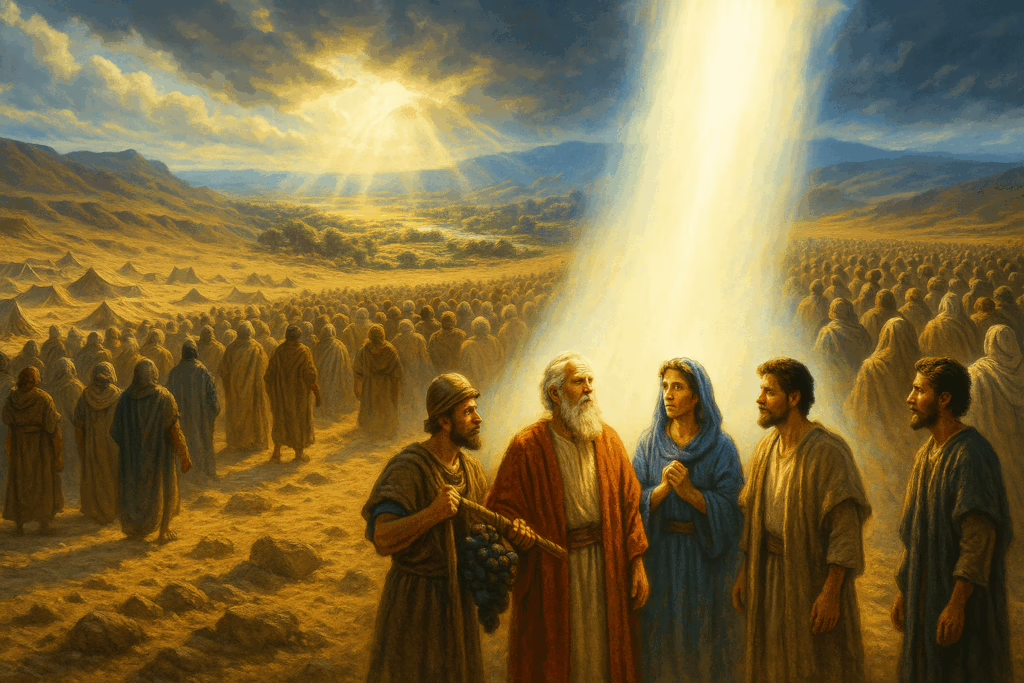
Then we hear the voices of Joshua (Yehoshua) and Caleb (Kalev) – two men who had seen the same land as the other spies, but with a completely different perspective.
They tore their garments, a sign of grief and a call to repentance, and said to all Israel:
“The land we passed through to spy out is an exceedingly good land.
If the L-RD delights in us, then He will bring us into this land and give it to us,
a land which flows with milk and honey.”
Notice what shapes their thinking:
- They remember what G-d has said about the land.
- They interpret circumstances through G-d’s promises, not through fear.
- They affirm that the land is not something Israel will seize by their own strength, but something G-d will give.
For Joshua and Caleb, G-d’s Word was more real than the giants.
For the rest of the people, the giants were more real than G-d’s Word.
They add a crucial warning and encouragement:
“Only do not rebel against the L-RD,
nor fear the people of the land, for they are our bread;
their protection has departed from them, and the L-RD is with us. Do not fear them.”
The people of the land were not to be feared; they were to be “bread” – nourishment in the process of walking in G-d’s will. Obedience would not destroy Israel; it would strengthen them.
Fear vs. Faith
The core issue in Numbers 14 is fear.
Fear paralyzed the people. Fear distorted their thinking. Fear led them to see giants and see themselves as grasshoppers.
What is the solution to fear?
Biblically, there is one answer: faith.
In Hebrew, the word for faith (emunah) is related to the word for truth (emet). Faith is not blind emotion; it is a response to truth. Faith believes what G-d says. Faith clings to His character and to His promises.
- When we walk in faith, we fear G-d above all.
- When we do not fear G-d, we end up fearing people, circumstances, and the future.
Joshua and Caleb knew that the L-RD was with them because they were in covenant with Him. Covenant means that G-d is “for” His people, that He desires to bless them, guide them, and bring them into His purposes.
The Majority Can Be Dead Wrong
Perhaps one of the most sobering lessons of this chapter is this:
The majority of G-d’s people can be completely wrong.
All but four – Moses, Aaron, Joshua, and Caleb – chose rebellion. They wanted to go back to Egypt. They wanted to stone the very men G-d was using. They were ready to kill those who were calling them to obedience.
This pattern explains why it is naïve to say,
“If this were truly from G-d, all our leaders would have embraced it.”
Israel’s history repeatedly shows that the people of G-d often resist His messengers, misunderstand His purposes, and reject His direction. The question is not what the majority think, but what G-d has said.
G-d Changes Our Perspective
The good news is that G-d is not limited by our natural thinking.
If we submit to Him, He will:
- Change our perspective
- Align our desires with His will
- Teach us to discern truth from error
- Lead us into His purposes
When we are committed to the will of G-d, we are never truly alone. Like Joseph in Egypt, we may be isolated, misunderstood, or opposed, but the L-rd will be with us.
A Call to Commitment
Numbers 14 confronts us with a serious question:
What are you truly committed to?
- Your own plans, desires, and comfort?
- Or the revealed will of G-d in His Word?
We have two options:
- To long for “Egypt” – the old life, the old patterns, our own control.
- Or to trust G-d, move forward, and enter the fullness of what He has prepared.
When we decide to be faithful to G-d’s plans, His purposes, and His covenant truth, He will work in our lives, change our perspective, and give us discernment to walk in His will.
May we be more like Joshua and Caleb than like the grumbling crowd.
May we choose faith over fear and obedience over rebellion.
Shalom from Israel.
Visit LoveIsrael.org for more Bible teachings, articles, and video messages from Dr. Baruch Korman
You can also watch this full teaching on YouTube at LoveIsrael Channel or listen through the My Bible Study mobile app.