In today’s passage, the subject is not “worship” by direct statement, but the entire narrative teaches a decisive principle about worship: true worship must be different. It is not of the world, and it must not be mixed with the world. When worship is blended with worldly patterns, worldly aesthetics, or worldly priorities, it stops being worship as G-d defines it.
If we examine much of what is called worship in many places today, we can observe a troubling trend: worship that increasingly resembles entertainment. At times it mirrors a nightclub atmosphere more than a sanctuary where the Holy G-d—the G-d of Israel—is reverenced. This passage in 1 Samuel 5 shows that G-d will not allow a mixture. He will not tolerate treating His presence as one item among many religious objects.
The Background: Judgment as Discipline, Not Destruction
The ark of G-d had been captured by the Philistines. This was part of G-d’s discipline toward His people. Scripture teaches that discipline is not for annihilation but for transformation: “Whom the L-rd loves, He disciplines.” G-d corrects because He is faithful and because He intends a change that produces a future testimony pleasing to Him.
This matters because worship is not merely emotional expression; it must be “in Spirit”—led by the Holy Spirit—and “in truth”—aligned with the Word of G-d. The narrative of 1 Samuel 5 exposes a fixed reality: G-d will not allow worship to be mixed with idolatry, nor His holiness to be treated casually.
1) The Philistines Take the Ark and Place It in Dagon’s Temple (1 Samuel 5:1–2)
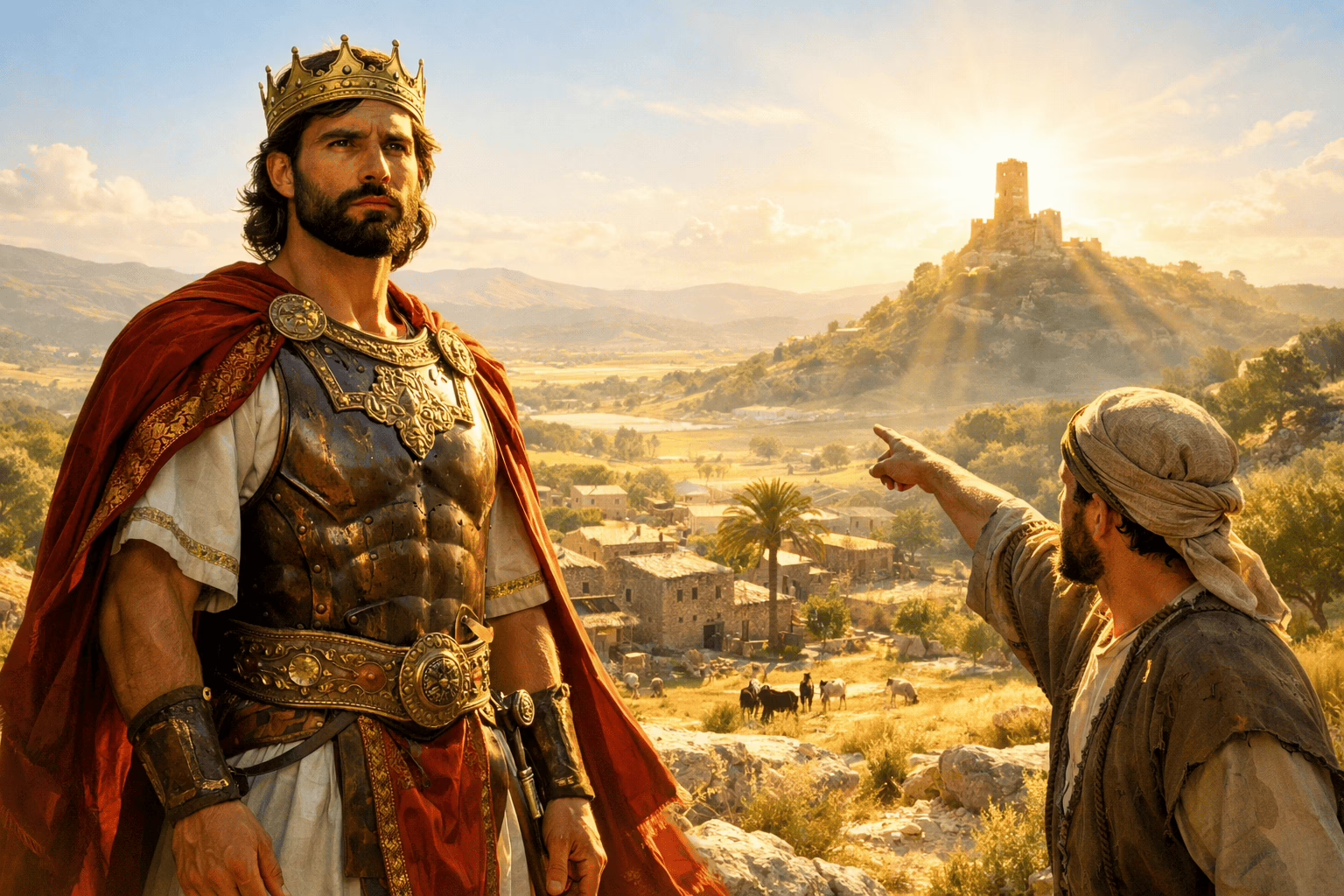
The text begins: the Philistines take the ark from Ebenezer to Ashdod, a coastal city. Then they bring the ark into the “house” (meaning temple) of Dagon—a Philistine deity associated with the sea, tied to fish imagery, worshiped by a seafaring people.
The passage emphasizes that they placed the ark “securely” near Dagon. The Hebrew term includes the idea of stability, as if the Philistines were attempting to position the ark within their controlled religious system. The implication is clear: they believed they could contain the presence of G-d, subordinate it, or at minimum integrate it.
But the central question is this: Can man stabilize G-d? Can man control G-d?
The answer is no. G-d transcends human power and human religion. Therefore, G-d is about to teach Ashdod—and the Philistines—a lesson about worship and sovereignty.
2) The First Humiliation of Dagon (1 Samuel 5:3)
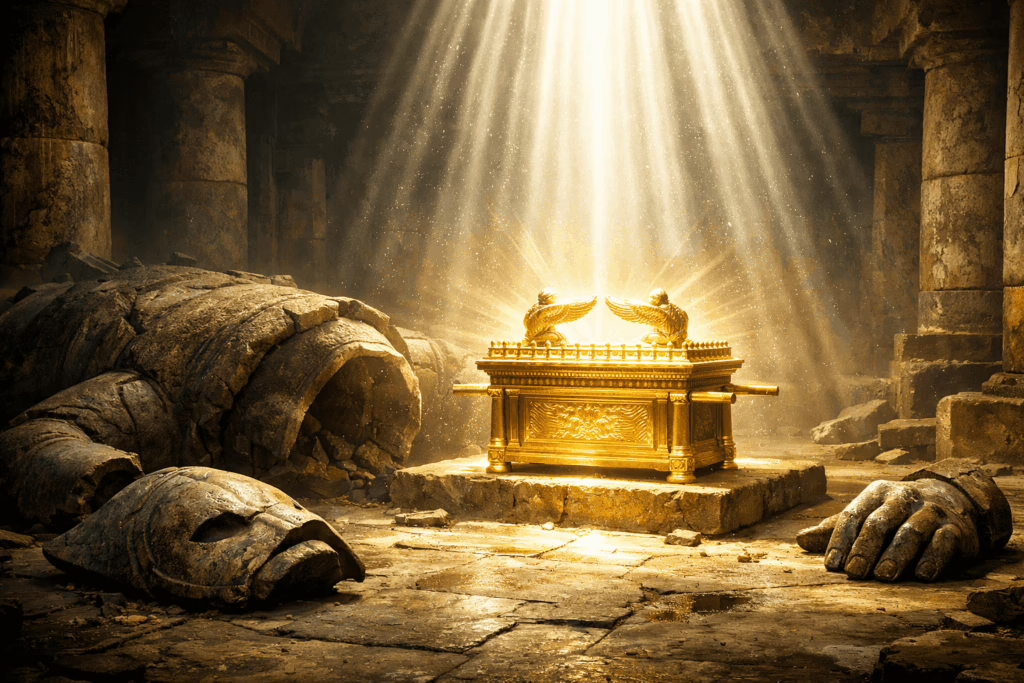
The text says the people of Ashdod rose early “the next day” and behold—something of great significance has happened: Dagon has fallen face-down before the ark.
This is not an accident. It is humiliation. The false G-d cannot provide stability. And the principle is simple: when people worship what is not G-d, they cannot expect security or order. False worship produces collapse.
At this point the text shifts in wording: it moves from “the ark of G-d” to “the ark of the L-RD.” The covenant name of G-d emphasizes His eternal sovereignty—He was, is, and will be. This change highlights the theological point: the G-d of Israel is not merely “a G-d” placed beside another. He is the L-rd who transcends all.
The Philistines respond by taking Dagon and setting him back “in his place.” But the narrative is foreshadowing something larger: G-d will ultimately displace every false worship system, because idolatry is never acceptable to Him.
3) The Second Humiliation: Dagon Is Cut Off (1 Samuel 5:4)
Again, the next day, Dagon is found fallen before the ark. But now the judgment intensifies: his head and the palms of his hands are “cut off.” This matters. The text does not primarily describe “breakage.” It describes cutting, which carries judicial meaning—removal, rejection, separation.
The symbolism is direct:
- The head represents authority, leadership, governance.
- The hands represent power, ability, action, accomplishment.
G-d is making a statement: this false G-d has no authority and no power. Only a torso remains—something incapable of rule and incapable of work. G-d is progressively removing what is unacceptable, showing that He will not share space, honor, or worship with idols.
And we learn another principle: G-d makes changes in order to restore proper order. When people order their lives by their own understanding, the result is disorder from G-d’s perspective. Therefore, the correct posture is worshipful submission:
“G-d, put my life in order. Make the changes You require.”
4) The Threshold Becomes a Lasting Testimony (1 Samuel 5:5)
Because of what G-d did, the priests of Dagon would not tread on the temple threshold “to this day.” The point is not superstition but impact: G-d’s intervention produced a behavioral change. For generations, they had maintained their worship patterns, but G-d’s activity forced a recognition that something was different.
This is what G-d requires from His people as well: a transformed life. A person cannot encounter the holy G-d and remain unchanged.
5) G-d’s Hand Becomes Heavy on the People (1 Samuel 5:6–7)
Now judgment shifts from the idol to the worshipers. The “hand of the L-RD” is described as heavy upon the people of Ashdod. The result is desolation and suffering—tumors break out in the city and its borders. The people conclude correctly: the ark of the G-d of Israel cannot remain with them, because His hand is heavy on them—and on Dagon.
Here the text exposes the next failure: they acknowledge the power of the G-d of Israel, but they resist true repentance. They want relief without surrender.
6) The Ark Is Sent from City to City, and Judgment Spreads (1 Samuel 5:8–11)
They gather the Philistine rulers and decide to move the ark to Gath, one of the five major Philistine cities (Gaza, Ashkelon, Ashdod, Gath, Ekron). The text uses a term meaning “turn”—as though relocating the problem will resolve it.
But when the ark arrives, the hand of the L-RD is again present, and the city experiences a severe disturbance—an uproar—and tumors spread. Then they send the ark to Ekron, and the people cry out in fear: “Send the ark away, so that it will not kill me and my people.”
Notice the pattern: the closer the ark comes, the more severe the disruption becomes. This is not because G-d is unstable; it is because false worship cannot coexist with His holiness. What they call “the problem” is actually the confrontation of G-d’s presence against idolatrous mixture.
Finally, the rulers agree: send the ark back to its place, because “there was a disturbance of death in all the city” and the hand of G-d was “very heavy” there.
7) The Conclusion: Improper Worship Produces Judgment (1 Samuel 5:12)
The chapter ends with a cry rising to heaven. The message is unavoidable: G-d judges worship that is mixed with the world.
The Philistines attempted to place the ark—representing the presence and authority of G-d—inside a temple devoted to a false deity. They treated G-d’s holiness as compatible with idolatry. G-d rejected that arrangement. And He did so publicly and progressively:
- He humiliated Dagon.
- He cut off Dagon’s “authority” and “power.”
- He afflicted the worshipers.
- He moved them from denial to desperation.
Practical Application: G-d Brings Change in Two Ways
G-d can bring change through His Word—so you recognize your need, repent, and submit willingly. Or G-d can bring change through the heaviness of His hand—discipline and judgment that force a confrontation with reality.
Wisdom chooses submission early.
Final exhortation:
Acknowledge the G-d of Israel. Worship must be set apart. It cannot be mixed with the world. Worship in Spirit and in truth is not optional; it is commanded.
Visit LoveIsrael.org for more Bible teachings, articles, and video messages from Dr. Baruch Korman
You can also watch this full teaching on YouTube at LoveIsrael Channel or listen through the My Bible Study mobile app.