Today’s passage centers on worship, and one of the most essential expressions of worship is offering. To worship G-d biblically means having the privilege to give—to participate generously in what the L-rd desires us to be involved in. Worship reveals our trust, dependence, and faithfulness toward G-d. We give not reluctantly, nor after anxious calculation, but willingly, because G-d has commanded it.
A foundational principle must be remembered: we can never outgive G-d. G-d is always more generous than His people. Whatever He calls us to do, He also provides the means to do it. His provision enables obedience.
With this understanding, we turn to Numbers chapter 15, beginning in verse 1. This chapter teaches us how worship is expressed through giving, submission, and obedience to G-d’s revealed will.
1) G-d’s Revelation Leads to Worship (Numbers 15:1–2)
The chapter begins with G-d speaking to Moses. Divine revelation always has a purpose—it teaches G-d’s people how to live, how to worship, and how to place Him first.
G-d instructs Moses to speak to the children of Israel regarding their entrance into the land of their dwelling places. This language is significant. The land is not merely territory; it is a place of divine appointment and permanence. G-d emphasizes that He is giving the land—the present tense in Hebrew highlights certainty and divine sovereignty.
From a kingdom perspective, this dwelling in the land points beyond Israel’s immediate future. Scripture teaches that believers—Jewish and Gentile alike—will ultimately dwell with Messiah forever. G-d’s covenant purposes for the land of Israel remain intact, and the church does not replace Israel but supports G-d’s redemptive plan centered there.
2) Worship Expressed Through Offerings (Numbers 15:3)
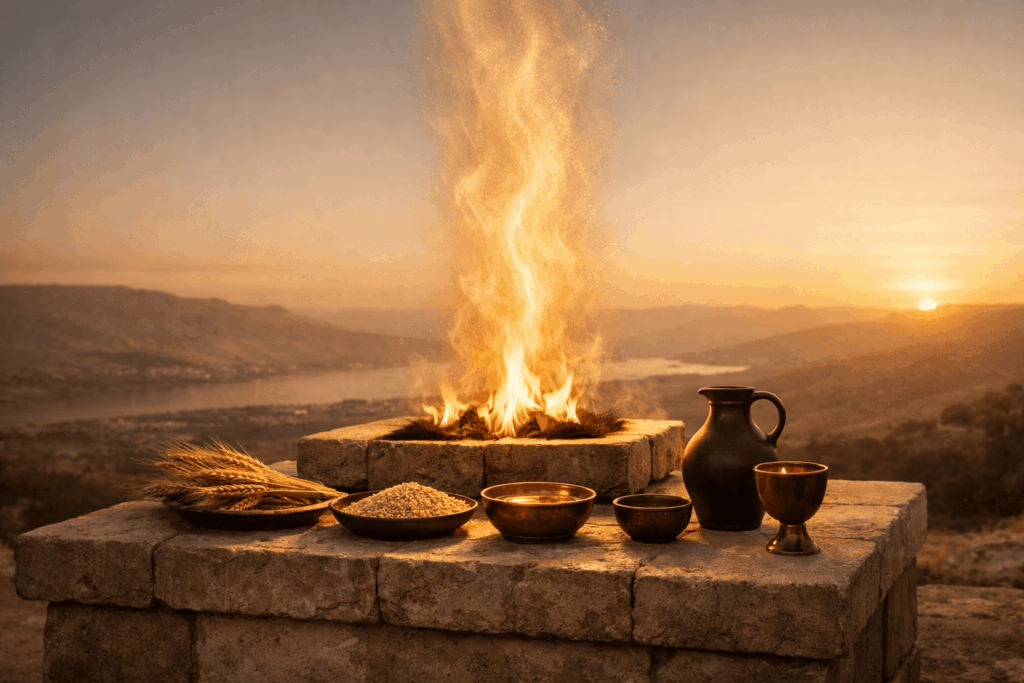
Upon entering the land, the people are instructed to bring offerings to the L-rd. Worship here is not abstract; it is tangible and sacrificial.
These offerings include burnt offerings, sacrifices, vows, freewill offerings, and appointed festival offerings. The Hebrew language emphasizes that fulfilling a vow is not merely an obligation but something marvelous and good. Obedience is beautiful to G-d.
Offerings are described repeatedly as producing a pleasing fragrance before the L-rd. This repetition teaches us that worship is meant to delight G-d, not express human preference. Worship does not originate in personal creativity but in submission to divine instruction.
3) Prescribed Worship, Not Self-Designed Worship (Numbers 15:4–10)
G-d carefully specifies how offerings are to be brought: grain offerings mixed with oil, wine libations measured precisely, and sacrifices chosen according to availability. Nothing is left to human improvisation.
Oil, often symbolic of the Spirit, appears consistently, reminding us that true worship is inseparable from G-d’s presence. Worship is not self-directed—it is shaped and governed by G-d’s Word.
This teaches an essential truth: true worship begins with listening. We do not decide how G-d should be worshiped; we respond to how He has revealed Himself.
4) Unity in Worship: One Law for All (Numbers 15:11–16)
A critical theological principle emerges in this passage: there is one law for the native-born Israelite and for the sojourner. The Hebrew term refers to those who dwell permanently among the people, not temporary visitors.
Once someone commits to dwelling among G-d’s people, they are called to the same standard of worship. This reveals a profound unity: worship is not determined by ethnicity but by covenant participation.
In Messiah, this unity reaches its fullness. G-d shows no favoritism—Jew and Gentile are brought together through faith. The gospel is the instrument G-d uses to bring all humanity into His family.
The text calls this instruction a “statute of olam”—a kingdom-related ordinance. It is not limited to one generation but carries enduring relevance tied to G-d’s kingdom purposes.
5) Offering the First: A Testimony of Faith (Numbers 15:17–21)
The passage continues with instructions regarding the elevation offering (terumah). When the people eat from the bread of the land, they are commanded to lift up a portion to the L-rd.
The first of the dough—referred to by the word challah—is set apart as an offering. This act acknowledges that the harvest comes from G-d and belongs to Him. Giving the first portion testifies to trust, gratitude, and recognition of divine provision.
This offering is commanded throughout your generations, revealing a lasting principle:
G-d sustains His people so that they may worship Him.
Provision is not the ultimate goal—worship is.
6) Worship, Redemption, and Transformation
True worship requires redemption. Without the Holy Spirit, no one can worship G-d in spirit and in truth. Faith in the gospel—believing that Messiah died for our sins, was buried, rose again, and ascended to the Father—results in the indwelling of the Holy Spirit.
This Spirit empowers believers to worship rightly, to obey joyfully, and to become a pleasing aroma before G-d. We are not saved by works, but salvation produces obedience. Grace leads to submission, not rebellion.
Every true believer, redeemed by the blood of the Lamb, is called to worship G-d according to Scripture. This worship brings transformation—eternal change through the presence of G-d.
Conclusion
Worship is not optional. It defines G-d’s people. No one else in the world can worship G-d except those redeemed by the Lamb. Through obedient, Scripture-based worship, we draw near to G-d, experience His presence, and are forever changed.
True worship unifies believers—Jew and Gentile alike—because it rests on G-d’s Word, not human preference.
Visit LoveIsrael.org for more Bible teachings, articles, and video messages from Dr. Baruch Korman
You can also watch this full teaching on YouTube at LoveIsrael Channel or listen through the My Bible Study mobile app.