
When we speak about biblical worship, there is a word that must always be present in our understanding: sacrifice.
True worship before G-d is never passive. Whenever we come before Him in worship, there must be a willingness to give, to offer, and ultimately to surrender. Scripture teaches us that G-d is love, and that love is demonstrated through giving. “For G-d so loved the world that He gave His only Son.” Giving is not optional—it is central to the very character of G-d.
Therefore, when G-d truly changes us, that same spirit of sacrifice will be evident in our lives. Worship that pleases G-d always involves surrender.
One of the challenges we face today when discussing biblical worship is that there is no physical temple and no altar for sacrifices. In the festivals of the L-rd, every appointed time required sacrifice. Even on Shabbat, when the Temple stood in Jerusalem, sacrifices were offered. Today, that system no longer exists, which places us, in one sense, at a disadvantage.
However, Scripture reveals a greater reality. As Paul teaches in Romans 7:6, we now worship G-d in the newness of the Spirit. True worship is only possible when we are led by the Spirit of G-d. When worship is genuine, it results in righteousness and reveals the glory of G-d.
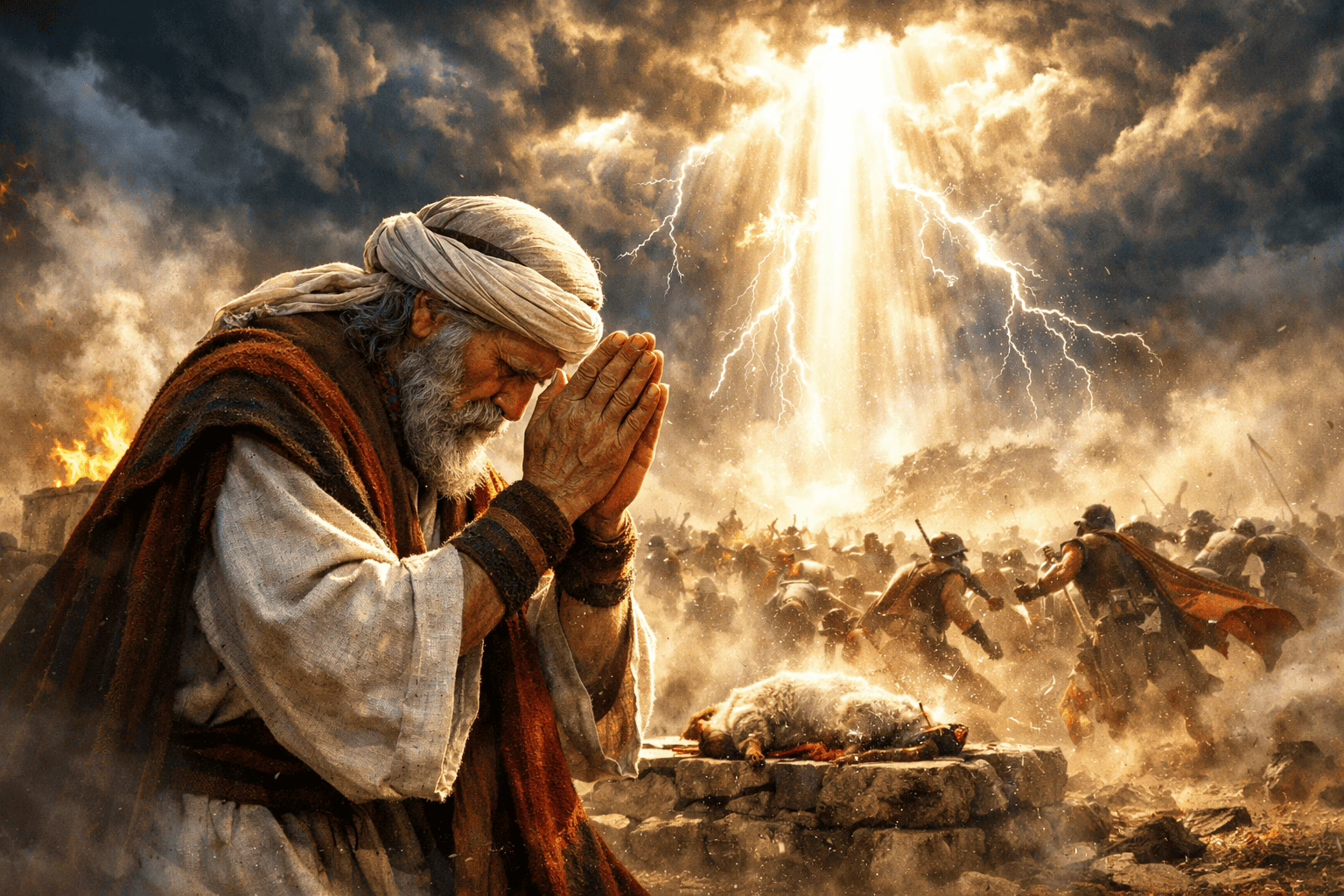
Biblically, worship is always connected to the manifestation of G-d’s presence. On the Day of Atonement, when the high priest entered the Holy of Holies, G-d manifested His presence in a cloud. What brought about that manifestation? Sacrifice, surrender, and obedience.
This brings us to one of the most important Hebrew concepts of worship: korban, which comes from a verb meaning to draw near. Worship is not merely an act; it is a movement toward G-d. We do not approach Him empty-handed. Worship requires offering.
Another word connected to worship speaks of prostration and surrender—lying before G-d in submission. As the rabbis teach, worship requires yielding the self. This aligns perfectly with Paul’s exhortation to present ourselves as a living sacrifice, not merely acceptable, but well-pleasing to G-d. Worship is not about doing the minimum; it is about honoring G-d fully.
Prayer is also inseparable from worship. In Hebrew thought, worship and prayer are intertwined, and prayer always expects a response from G-d. Worship invites G-d to act, to prune, to remove what does not belong. A worship experience that pleases G-d will always involve transformation.
The greatest biblical example of worship is found in Messiah Yeshua Himself, particularly in the Garden of Gethsemane. There is no greater act of worship than what He demonstrated when He laid down His life.
In Matthew 26, we see that worship begins with revelation. After Messiah completed His teaching, He prepared His disciples for what was coming. As disciples—those who live under the authority of their Master—they were being taught the true meaning of worship: total submission to G-d’s will.
Passover is central to this moment. Passover always speaks of death, but death with purpose—death that brings redemption. Either the Passover lamb dies, or death falls upon the firstborn. There is no third option. Messiah reveals that He Himself is that Passover Lamb.
In Gethsemane, we see worship defined clearly. Messiah was not joyful. He was deeply grieved. This teaches us something crucial: worship is not about pleasing ourselves. Worship is not emotional satisfaction; it is obedience.
When Yeshua prayed, “Not as I will, but as You will,” He gave us the clearest definition of worship. Worship is denying self and submitting completely to G-d’s will—even when it is painful.
The flesh will never agree with G-d. The flesh is sick, corrupted, and must die. True worship happens only when the flesh is crucified and the Spirit leads.
Messiah’s command to His disciples was clear: watch and pray. Watching is a military term—it means being alert to the enemy. The only way believers remain faithful is through prayer and dependence on the Spirit.
In the Garden of Gethsemane, Messiah defined worship once and for all:
Worship is dying to self so that G-d’s will may be accomplished.
If we are not willing to die to ourselves, we do not possess a faith that pleases G-d. True worship transforms us, prunes us, and prepares us to live for His glory.
Visit LoveIsrael.org for more Bible teachings, articles, and video messages from Dr. Baruch Korman
You can also watch this full teaching on YouTube at LoveIsrael Channel or listen through the My Bible Study mobile app.